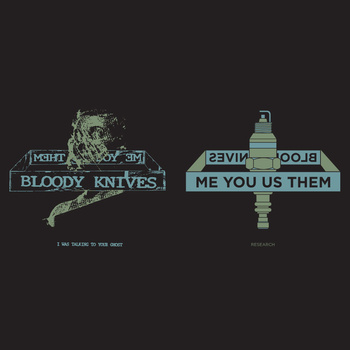
Whether the gateway drug function of split seven-inches has been diminished by file-sharing and streaming media is up for debate, but even if it’s no longer the easiest way to encounter a few new bands, the format can still work. Consider this split between Brooklyn’s Me You Us Them and Austin’s Bloody Knives, which has already prompted me to track down their respective 2010 full-lengths.* Both bands have been lumped in with the shoegaze revival, which fits Bloody Knives better than Me You Us Them, but neither band should be discounted as a stock “Fender Jaguar + Boss PN-2 Tremolo Pan Pedal = Shoegaze!” act. That alone should pique your interest, but an interesting bait and switch on the part of Me You Us Them should maintain it.
Bloody Knives pull off a neat trick with “I Was Talking to Your Ghost”—as the drums, guitar fuzz, and especially bass speed along, Preston Maddox’s vocals float calmly overhead, seemingly disinterested by the racing pulse below. It’s not far off from Oliver Ackermann’s approach in A Place to Bury Strangers, but the lack of gothic overtones to Maddox’s vocals is refreshing. Bloody Knives’ 2010 LP Burn It All Down offers a bit more variety, hitting on the drum-machine dream-pop of early Cocteau Twins, the aggression of APTBS, and the 8-bit textures and bright melodies of the sadly departed Depreciation Guild. Burn It All Down is available for free download from Bandcamp right now. Keep an eye out for their upcoming remix album, Burn It All Up, which should be available from Killredrocket Records in the near future.
No shoegaze touchstones are needed for Me You Us Them's "Research." If you’d told me in January that I’d make a positive comparison to ’90s Amphetamine Reptile outfit Calvin Krime in a 2011 review, I’d assume that either Sean Tillman came out with an atypically aggressive Sean Na Na or Har Mar Superstar single, not that an unfamiliar band was mining similar territory. But the combination of abrasive screaming, driving three-piece rock, and a pressure-relieving melodic chorus recalls the Calvin Krime playbook. It’s hard to tell if the melodic lead is treated guitar or fuzzy synth, but either way, it’s been floating through my head the past few days. I don’t mean to sell MYUT short with the Calvin Krime comparison, especially since that band might not have pulled off this song’s bass-driven bridge or the buried vocals of “Will we ever wake up?” building into screams in the outro as deftly, but I appreciate revisiting the sound.
Here’s the real shocker: “Research” is an outlier in Me You Us Them’s catalog. I missed the boat on their 2010 Post-Data full-length, but it offers a striking mix of Polvo’s woozy riffage, Paik’s early guitar textures (especially Hugo Strange), and the Swirlies’ off-kilter melodies with a touch of punk aggression. In other words, it fits into a fine tradition of using shoegaze impulses in more muscular, less ethereal song structures. “As of Now” is a good starting point.
Considering that I’ve checked out both band’s albums and am particularly keen on spending more time with Me You Us Them’s Post-Data, you can easily chalk this split up as a rousing success. You can stream both songs over at Bandcamp and order the 7” from Triple Down Records or Killredrocket Records.
* The ability to quickly follow up on each of these bands is a welcome departure from the old routine of split singles, when I’d hear a great new band only to learn that their only other released tracks are on an out-of-print local compilation, their albums are only available in Denmark, or they’d split up before recording a full-length.
|

After clearing the decks in 2009 with National Skyline’s first full-length (Bliss & Death) since 2001’s This Equals Everything and two companion EPs (Look into My Eyes and Bloom), Jeff Garber laid low in 2010. His only releases were the digital singles “Ashes” and “Do You.” Garber slinks back into the spotlight with the unannounced Broadcasting, Vol. 1 EP, picking up where Bliss & Death’s more languid tracks left off.
Opening track “When I’m Alone” showcases Broadcasting’s bag of tricks: acoustic guitar, gossamer guitar overdubs, distant drum machines, and Jeff Garber’s weary vocals. It’s lyrically thin, repeating lines like “When I’m alone / I get so lost / When I’m alone / I get so tired of my life” as breadcrumbs to make it out of the instrumental mist.
Here’s the rub: “When I’m Alone” showcases all of Broadcasting’s bag of tricks. Granted, live drums replace the drum machines on the final three songs and “Walk Away” adds simple piano, but Garber seems glued to mellow acoustic balladry. If the songs were compelling, perhaps I could overlook the sonic similarities, but that’s not the case. The lazy song titles (“When I’m Alone,” “I’ll Be Allright” [sic], “Stay with Me,” “Walk Away,” “I’ll Stay with You”), trite lyrics, and numbing lack of energy turns Broadcasting, Vol. 1 into sentimental mush.
Garber’s been here before. The Joy Circuit’s EP1 and National Skyline’s The Last Day EP both suffer from thin lyrics and generic aesthetics. I’ve previously cited the lyric “Hey you / I know you / This is not where you belong” from The Joy Circuit’s “They Know Where You Live” as a painfully a propos reading of Garber’s output since This Equals Everything and his residency in Los Angeles. Yet Bliss & Death revived most of my faith in Garber and National Skyline. There’s a “fooled me twice—shame on me” quality to Broadcasting, Vol. 1, one that I take no pleasure in relaying.
Here’s my theory. Broadcasting, Vol. 1 is a dumping ground EP for Garber’s latest batch of TV placement songs. The soupy melodrama of “The Last Day” wasn’t a great follow-up to “A Million Circles,” but it did appear in a key scene of the third season of Veronica Mars. (An ironically appropriate placement, given that season’s infuriating lack of direction and inspiration.) At least four of National Skyline’s tracks have appeared on MTV’s cultural touchstone Jersey Shore: “Do You,” Bliss & Death’s “Edge of the World” and “Revenge,” and “Look into My Eyes.” If digital single sales are way up and album sales are way down, it’s likely that Garber gains more fans and earns more money by getting those songs on Jersey Shore than releasing an album of them like Bliss & Death.
My issue isn’t with Garber’s decision to monetize his music via MTV reality series. The man has to eat. My issue is that the songs on Broadcasting, Vol. 1 are tailor-made for that purpose. I know Garber can write an affecting lyric—“Five Hours Later,” “Tracking Sounds Alone,” “Miss Atlantic,” “This Is Not a Test,” and “Kandles” all qualify—but the on-the-nose emotions of “I’ll Be Allright” are all surface, no depth. How easy would it be to fit lines like “I’m going to be all right, you’ll see / No need to worry about me” and “I won’t call you anymore / And I won’t be there when you’re alone” into a tender post-break-up scene? Is there any other context for it? It’s admittedly not that far off from the pained semi-yodels of “Tracking Sounds Alone”—“I looked you up in the telephone book / I took my phone off the hook” and “I wish you rang / And I wish I sang”—but there’s a complexity (not to mention a genuineness) to the emotion in “Tracking Sounds Alone” as Garber careens between regret, pride, self-doubt, and optimism. Nothing on Broadcasting offers that complexity or rings so true. (Nor can I imagine “Tracking Sounds Alone” being used as background music.)
Does this mean that the proper follow-up to Bliss & Death will be a similar disappointment? Not necessarily. Only “When I’m Alone” seems like a candidate for inclusion, and it sounds more like a good b-side than a deep album cut. With more energy, more guitar overdubs, and better lyrics—i.e. the things that made Bliss & Death worth hearing—Garber’s back on track. But once you’ve gotten used to the on-the-nose lyrical approach, is it difficult to stop? That’s the big question. If Broadcasting, Vol. 1 is, as I suspect, a dumping ground for Garber’s potential TV placements, let’s hope it doesn’t pollute the groundwater of his main base.
|

When The Forms first announced that their next release would be a remix EP called Derealization, I was cautiously optimistic. The Forms are great; remix albums typically are not. Still, their track record insisted they could pull it off. The group’s two albums—it’s difficult to call them “full-lengths” when Icarus runs 18 minutes and The Forms runs 30—and stray covers (Billy Joel’s “We Didn’t Start the Fire,” R.E.M.’s “Ignoreland”) are universally excellent. Beyond their intriguing, off-kilter guitar tones and ear-worm vocal hooks, The Forms’ greatest strength is their ability to revisit and revise the past. Icarus applies the editorial acumen of Wire’s Pink Flag to mid 1990s emo like Sunny Day Real Estate, fragmenting the song structures without losing sight of the emotional charge. The Forms, an album that gets better with every spin, envisions an alternate universe of 1990s indie/emo/math-rock where groups like Polvo could really sing, placing the vocals on top of the mix instead of burying them beneath the shifting guitar patterns. Changing the vocal intonation of and adding a droning, post-punk bass line to “We Didn’t Start the Fire” cleansed decades of its brain-numbing melody. With only an hour of widely available music to date, I was thrilled to hear anything new from the Forms, but opting for a remix EP—and a much delayed one at that—over their first album since 2007 seemed strange.
I’d hoped to pick up a physical copy of Derealization when I saw The Forms play a snow-sabotaged set at T.T. the Bear’s on December 28, only to learn that it wouldn’t be available until February. Nevertheless, I gained a much clearer idea of what “remix” means to the Forms.
I expected to see a four-piece rock band, but I’d missed the announcement that The Forms had been pared down to a two-piece. Alex Tween and Matt Walsh set up their keyboards/midi controllers first, with only Walsh having guitars in tow. They opened with an accordion and steel drum rendition of “Knowledge in Hand,” followed it with a synthesizer and miniature guitar reimagining of “Focus,” then turned “Red Gun” into electro-pop. I knew the melodies and the lyrics, but each had been pushed and pulled to fit their new arrangements, none of which sounded remotely like Sunny Day Real Estate or Polvo. Every song added some new element to the mix—’80s drum pads, dexterous guitar riffs, falsetto vocal runs—and by the end of the set, I got it. The band had been remixed. No wonder why Derealization took so long.
That’s the difference between Derealization and the hit-and-mostly-miss remix compilations I have from other rock bands (Mogwai, Swirlies, Dismemberment Plan, Bloc Party, Isis, Explosions in the Sky, Minus the Bear, etc.): The Forms are actively working with these versions. Remix albums are closed circuits. Groups send their material out to remixers, who rearrange it, add their own touches, and generally apply their own aesthetic to it. Once these remixes have been collected, the respective aesthetics rub against each other awkwardly. Some work, some don’t. But even in the case of a truly successful remix—Justin Broadrick’s take on Pelican’s “Angel Tears,” Kevin Shields’ explosion of “Mogwai Fear Satan”—it’s a static object upon release. Mogwai and Pelican haven’t performed those versions live. The very thought of that—“We’ve been learning how to play this remix of our song and rehearsing it a lot”—sounds comical. Remixes aren’t usually written or treated like original songs.
Then again, Derealization isn’t a traditional remix album. It may have started out as one, but Tween and Walsh did the rearrangements, not outside contractors. Collaborators color the songs, but don’t fully dictate the sound. Derealization is halfway between a remix album and a sharp directional turn, like Bob Mould’s embrace of electronic music on Modulate (except, you know, good). These songs are built on old material, but they stand on their own as new compositions. Guest vocalists The National’s Matt Berninger, Pattern Is Movement’s Andrew Thiboldeaux, and (especially) Shudder to Think’s Craig Wedren excel with The Forms’ material. Tween’s vocals in turn have improved to better fit the pop nature of the new versions. New instrumental choices like strings, acoustic guitar, electronic programming, synth bass, and drum machines never seem out of place. The switch from rock to pop as the dominant genre tag seems all too easy, especially on the Wedren-fronted highlight “Finally.” If only all “remix” albums went through this ringer.
And the remixing—in terms of the band perspective—isn’t over. After seeing The Forms again last night (opening for the Dismemberment Plan), I was amazed by how different the songs are in the live setting: much more electronic, much more dance-oriented. It’s a jarring flip from anyone solely familiar with The Forms’ past work, but Derealization acts as a buffer between the eras. It’s also encouraging that The Forms played at least three new songs, suggesting that a new release might not be four years away.
Derealization is getting a CDEP pressing, but I recommend the stark collision of past and present on the upcoming LP pressing of Derealization, which puts the remix EP on one side and Icarus on the flip. It makes logistical sense—Icarus hits vinyl for the first time—but it also showcases two vastly different eras of the band in the same place. Maybe someday the rock band incarnation of The Forms will open for the electro-pop version.
|
|
